Most guides on scholarship recommendation letters are written for the student asking for one. They explain how to approach a professor, what information to give them, and how to follow up politely. This guide is for the other side of that conversation.
If a student has asked you to write a scholarship recommendation letter, you are holding something that matters considerably more than it might appear. Scholarship committees often read recommendation letters after forming an initial impression from the application itself. A strong letter confirms what the committee already suspects. A weak letter raises questions the application had not raised. And a letter that could have been written about anyone, regardless of how positive it is, effectively adds nothing to an application that needs to stand out.
This guide covers what scholarship committees actually look for in a recommendation letter, what the most common weaknesses are, how to structure a letter that serves the student you are recommading, and what to do if you cannot write a genuinely strong letter for this particular student.
What Scholarship Committees Are Actually Looking For
Before writing a single sentence, it helps to understand who will read your letter and what they are trying to learn from it.
Scholarship committees are typically composed of faculty members, alumni, foundation staff, or community representatives who read applications in batches. They have already seen the student's transcript, their personal statement, and their other supporting materials. By the time they reach the recommendation letter, they are looking for one thing that nothing else in the application can provide: an account of this student from someone who has observed them directly.
The most useful recommendation letters answer three questions that the committee cannot answer from the rest of the file.
First, what is this student like when the performance pressure of a formal evaluation is absent? Grades and personal statements are produced under conditions where the student knows they are being assessed. A recommendation letter should describe behavior that was not produced specifically for evaluation.
Second, how does this student compare to others you have taught or supervised? A committee reading that a student is hardworking and dedicated needs a frame of reference. Hardworking compared to whom? Among how many students over how many years?
Third, is there something specific about this student that the rest of the application cannot communicate? A personal statement is the student's own account of themselves. Your letter is someone else's account, and that difference matters. What would you say about this student that they could not credibly say about themselves?
The Structure That Works
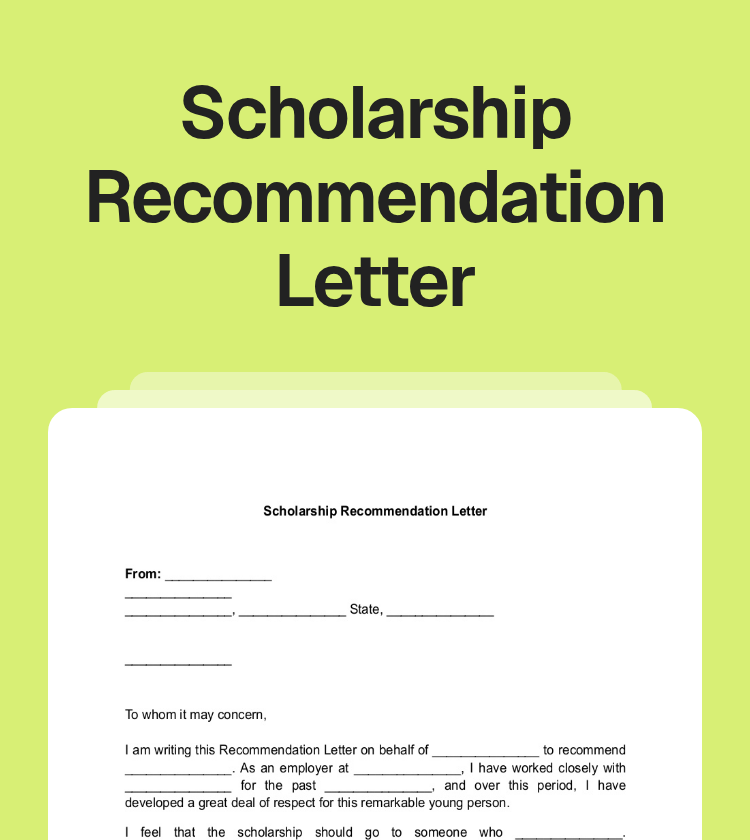
A scholarship recommendation letter that serves the student well typically follows this four-part structure. The total length should be between 400 and 600 words. Shorter letters read as insufficient. Longer letters dilute the strongest observations with filler.
Part 1: Your Relationship to the Student
The first paragraph establishes your credibility to write this letter. State who you are, your role, how long you have known the student, and in what capacity. Be specific about the nature of your observation: a professor who supervised a student's independent research project has a different kind of knowledge than one who taught them in a lecture course of two hundred students, and that distinction matters to the committee.
Weak version: "I have had the pleasure of knowing [Student Name] for two years in my capacity as a professor at [University]."
Stronger version: "I have known [Student Name] for three years. She completed my introductory course in her first year and then returned as a research assistant in my lab for the following two years, during which I worked directly with her on a data collection project involving [brief description]. I have observed her over a sustained period and in contexts that reveal more about a student than coursework alone."
The stronger version tells the committee immediately that this recommender has firsthand, extended knowledge of the student in a meaningful context.
Part 2: A Specific Example That Illustrates the Student's Core Quality
This is the most important paragraph in the letter and the one most often written too vaguely. Identify one quality that is central to why this student deserves the scholarship and illustrate it with a specific incident or observation rather than a general claim.
Weak version: "She is one of the most dedicated students I have encountered. She consistently goes above and beyond in her coursework and demonstrates exceptional commitment to her field."
Stronger version: "Last spring, the dataset we were working with contained a systematic error that none of us had caught. She identified it during an independent analysis she had conducted on her own time, after the project was considered complete by the rest of the team. She presented her findings to the group with a clear explanation of where the error originated and a suggested correction. That incident was not an assignment. It was initiative that nobody asked for and that she did not mention to me until she had already verified her conclusion."
The specific incident cannot be fabricated or generalized. It is the kind of detail that makes a committee member stop and pay attention.
Part 3: A Comparative Assessment
Place the student within a reference class so the committee can calibrate the strength of your endorsement.
This does not require ranking the student numerically or making claims that feel uncomfortable. It requires giving the committee enough context to understand what "strong" means in your experience.
Examples of effective comparative statements:
"In fifteen years of teaching this course, I have recommended fewer than five students for competitive fellowships. She is among them."
"Of the graduate students I have supervised, she is one of the few whose independent judgment I would trust on a project I was not directly overseeing."
"I teach approximately 200 undergraduate students per year. She is among the top three I have encountered in terms of intellectual curiosity combined with follow-through."
Each of these statements gives the committee a frame of reference without requiring the recommender to rank students against each other explicitly.
Part 4: The Forward-Looking Close
Close the letter with a specific statement about what you believe this student will do with the scholarship opportunity. This is not a place for generic encouragement. It is a place to connect the student's demonstrated qualities to the specific opportunity they are applying for.
If the scholarship is for study abroad, describe something specific about the student's openness to unfamiliar contexts that makes you confident in the prediction. If the scholarship is for a research program, describe a specific quality that makes them well-suited to independent research. If the scholarship is community-focused, describe something you have observed about how this student engages with people beyond their immediate peer group.
The close should end with a clear statement of endorsement: "I recommend [Student Name] without reservation for this scholarship" or "I support this application enthusiastically." Ambiguous closes read as hedged endorsements, which is worse than a shorter letter with a clear conclusion.
What Recommenders Most Often Get Wrong
Writing in superlatives without evidence. Calling a student "exceptional," "outstanding," or "one of the best I have ever taught" means nothing without the specific observation that earns the description. Every other recommendation letter in the pile uses the same vocabulary. Evidence is what separates them.
Repeating information already in the application. The committee has read the student's transcript and personal statement. Do not summarize the student's academic record or restate their stated career goals. Your letter should add information the application cannot provide.
Being warm but vague. A letter that describes a student as kind, collaborative, and enthusiastic communicates good character without demonstrating academic or professional capability. Scholarship committees need to believe the student will produce something with the funding. Warmth alone does not support that belief.
Writing a generic letter and changing the name. Committees read enough recommendation letters to recognize when one could have been written for any student. A letter that contains no detail specific to this student about this scholarship signals that the recommender did not invest time proportional to the stakes.
What to Do If You Cannot Write a Strong Letter
If a student has asked you for a recommendation and you do not feel you can write a genuinely strong one, the most useful thing you can do is tell them honestly before they submit your name.
A lukewarm recommendation letter, regardless of how positively it is worded, is detectable and often damaging. A committee that reads three letters and finds two strong and one hesitant will ask questions about the hesitant one that the student cannot answer.
It is better to say "I am not the right person to write this letter because I do not know your work well enough to be specific" than to submit a letter that raises doubts the application had not raised. Most students, given that information early enough, can identify another recommender who knows them better. Telling them early is a more useful act than protecting them from an uncomfortable conversation.
A Final Note on Logistics
Ask the student to provide you with a copy of the scholarship criteria, their personal statement, their resume or CV, and any specific qualities the scholarship committee has indicated they are looking for. This information makes your letter more targeted and reduces the likelihood that you emphasize qualities that the scholarship does not prioritize.
Confirm the submission deadline early, and build in enough time to write a considered letter rather than a rushed one. A letter written in twenty minutes reads like one. The student asked you because they believe you can represent them well. The letter you produce is the evidence for or against that belief.
For scholarship listings and application resources across every scholarship category and level of study, visit listscholarship.com.